Saana in Winter: A Guide for Reaching the Summit

Climb Saana all year round – here are our best tips for Kilpisjärvi’s most famous fell.
We are often asked whether it is possible to reach the summit of Saana in winter. In fact, enthusiastic hikers visit Saana almost daily even during the winter months, and apart from severe weather conditions, there are no real obstacles to making the ascent. During the polar night, the short hours of daylight naturally limit the hike, but even at the darkest time of the year there is enough light to reach the summit.
Saana is without a doubt one of Kilpisjärvi’s most beautiful and enduring favorites – so why not set out and experience it for yourself?
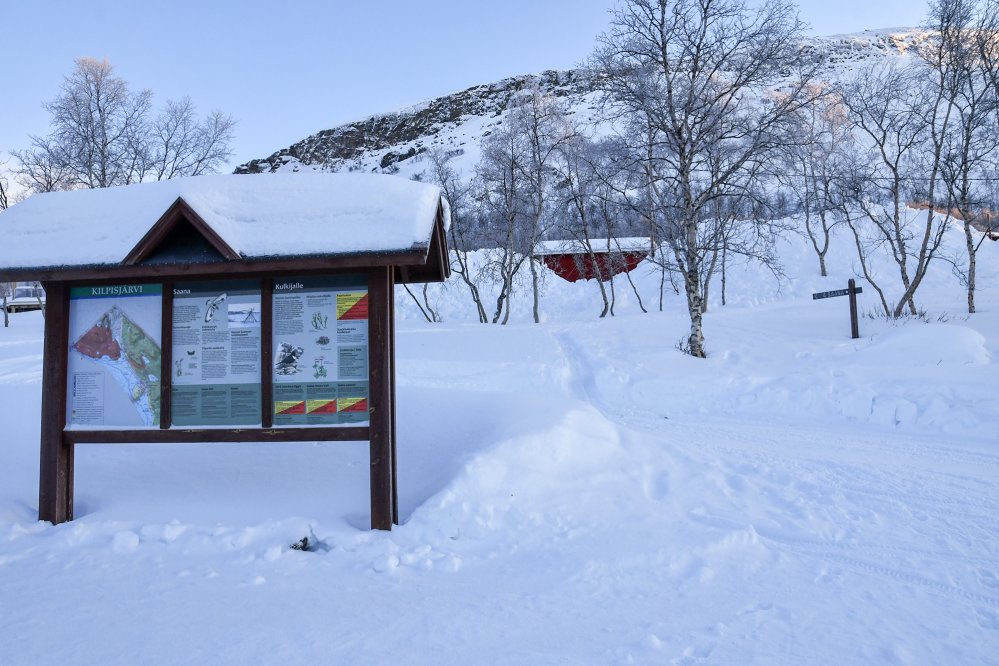
The starting point of the Saana trail is located at the northern end of Kilpisjärven Retkeilykeskus. Even in winter, the path is often clearly visible and can frequently be walked without snowshoes
Starting point
I set out towards the summit of Saana on a frosty February morning, with the Finnish Meteorological Institute reporting a brisk –25°C down in the village of Kilpisjärvi. When heading out on winter hikes, I always prefer to wear slightly too many layers – extra clothing is easy to remove if needed, but being cold is never pleasant.
As my base layer, I chose a merino wool set from the Norwegian brand Aclima. Wool is without question the best option thanks to its warmth and unbeatable moisture-wicking properties. On top of the base layer, I added a thicker wool sweater and two down jackets. For my legs, I wore lightly insulated winter trousers.
Saana is often windy, so it is always wise to bring along a windproof layer. This time, however, the combination of intense cold and the weather forecast told me that conditions at the summit would be almost completely calm, so I left my shell jacket behind.
In my backpack I packed a thermos of tea, a few snacks, a water bottle, my phone with a full battery, a camera with two lenses, and a tripod. Knowing that I would likely work up a sweat on the way up, I also added a dry spare beanie and a buff to change into along the way.
The starting point of the trail is located at Kilpisjärvi Retreat Center, about five kilometers from K-Market Kilpishalli in the direction of Norway. You can leave your car in the front yard of the main building.
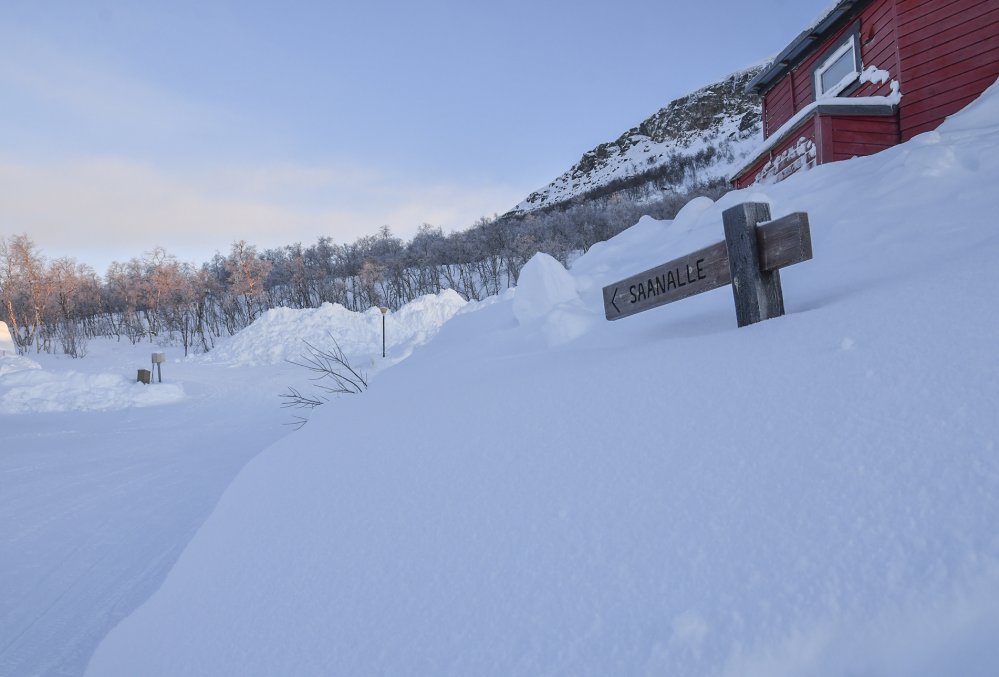
The trail continues from the edge of the caravan area. From this point, the distance to the summit of Saana is approximately four kilometers.
I set off from the yard of the Kilpisjärven Retkeilykeskus just before ten in the morning, as the sun was rising above the horizon. I couldn’t help but regret not leaving an hour earlier – only moments before, the newly risen sun had painted all the surrounding fell peaks in a brilliant shade of pale pink. There was no one in sight as I began my ascent from the edge of the Kilpisjärvi Retreat Center’s caravan area. The silence was broken only by the crunching frost snow beneath my boots and the distinctive, bubbling call of a willow ptarmigan echoing from a nearby fell birch grove.
In winter, snowshoes are often needed on the Saana trail. However, as no new snow had fallen during the long cold spell, I knew the path would be firmly packed thanks to steady foot traffic. For that reason, I was able to leave the extra weight of snowshoes at home.
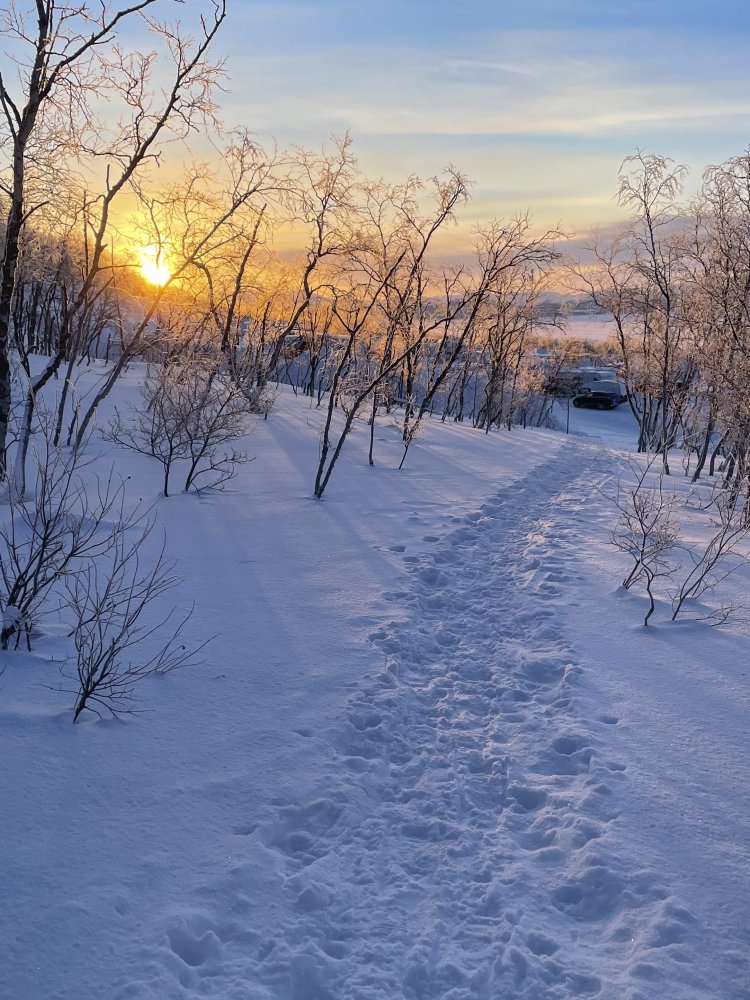
The trail was easy to follow the entire way without snowshoes. The morning sun did not yet provide any real warmth, and the temperature remained at –25°C.
The soft light of the rising winter sun soon filtered through the frost-covered fell birch forest, and I knew the day would be unforgettable. There is no need to fear the cold when climbing Saana – the most important thing is to dress warmly and in layers. It is also worth remembering that your body temperature rises the higher you climb. I noticed this myself very quickly, as after just half a kilometer of ascent I was already able to pack my outer down jacket into my backpack.
The first kilometer of the Saana trail runs through fell birch woodland. On the right-hand side, Saana’s steep slope rises dramatically, while on the left you can see Lake Kilpisjärvi and the charming Little Malla fell. In summer, and especially in early summer, this section of the trail can be wet, which is something to keep in mind when choosing your footwear.
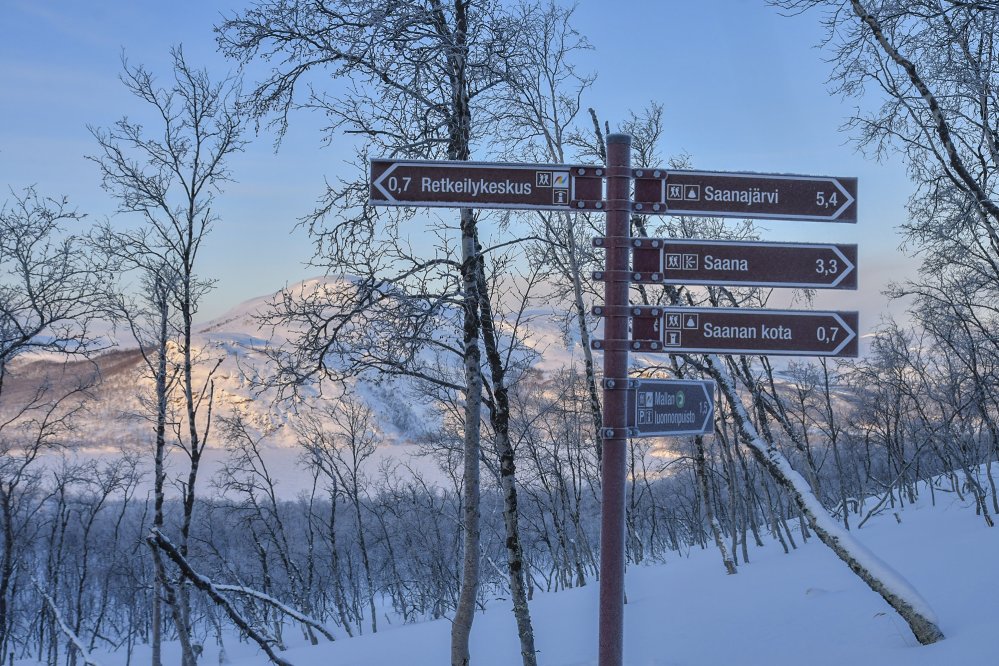
By ten in the morning, the sun had already risen, casting its light across the slope of Little Malla.
Almost immediately after passing the tree line, the views open far across Sweden and Norway. The fells Pältsa and Paras also come into sight – familiar from the legend of Kilpisjärvi’s origin.
According to the tale, Paras, an old seer, was about to unite the beautiful maiden Malla and Saana in marriage when dark Pältsa from Sweden arrived with the wizards of the Arctic Ocean to stop the wedding. A storm summoned by Pältsa and masses of ice surged from the north just before the couple could step before the altar. In that moment, the noble Saana swept Malla into his arms and carried her to safety on the shore of Kilpisjärvi. There, the two were frozen side by side beneath the ice, and from Malla’s tears Lake Kilpisjärvi grew to its present size.
— Tarujen tunturit (Fells of Legend), Asko Kaikusalo & Yrjö Metsälä, 1974
By ten in the morning, the sun had already risen, illuminating the slope of Little Malla.
On the open, treeless plateau known as Saanavankka, above the fell birch zone, the new Saana trail joins the trail that starts from Kilpisjärven Retkeilykeskus. The new Saana trail begins at the Malla parking area just before the Kilpisjärvi border station, although this parking area is not always plowed in winter. Slightly below the junction of the two trails, you will also find Saana’s new and beautiful wilderness hut (kota), a perfect place to stop for a fire and enjoy your packed lunch.
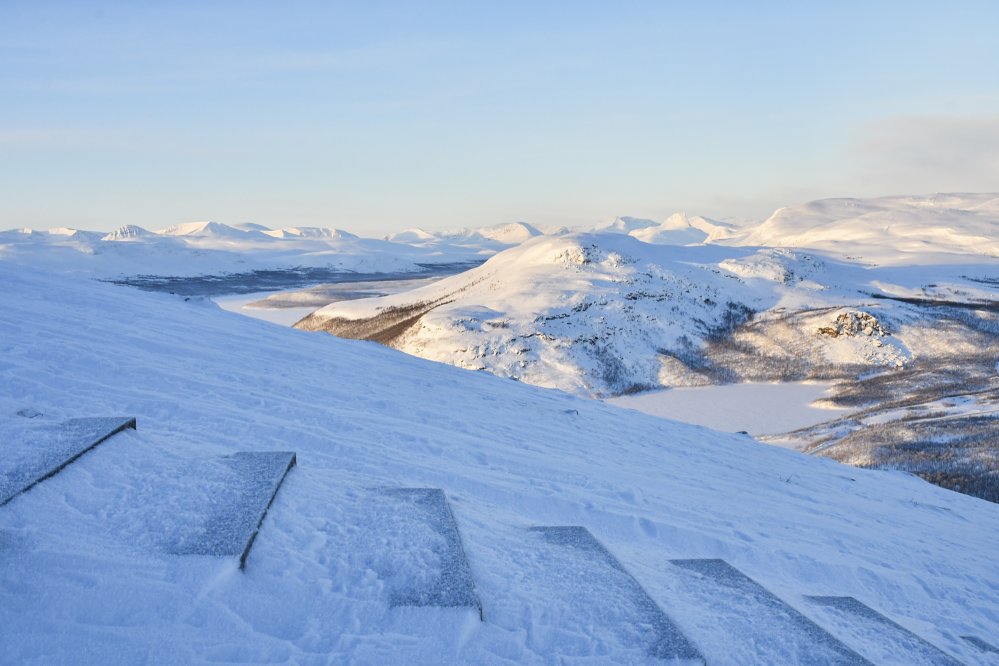
After leaving the fell birch forest behind, the steepest part of the ascent begins. To make this section easier, stairs have been built along the route. In winter, however, the steps offer little help, and the stone treads occasionally visible beneath the snow can be icy and slippery. The slopes of Saana are often windy, sometimes fiercely so, which prevents snow from accumulating on the hillside. While snowbanks in the village of Kilpisjärvi may exceed a meter in height, on Saana you may still spot tiny shrubs peeking out from beneath the snow even in midwinter.
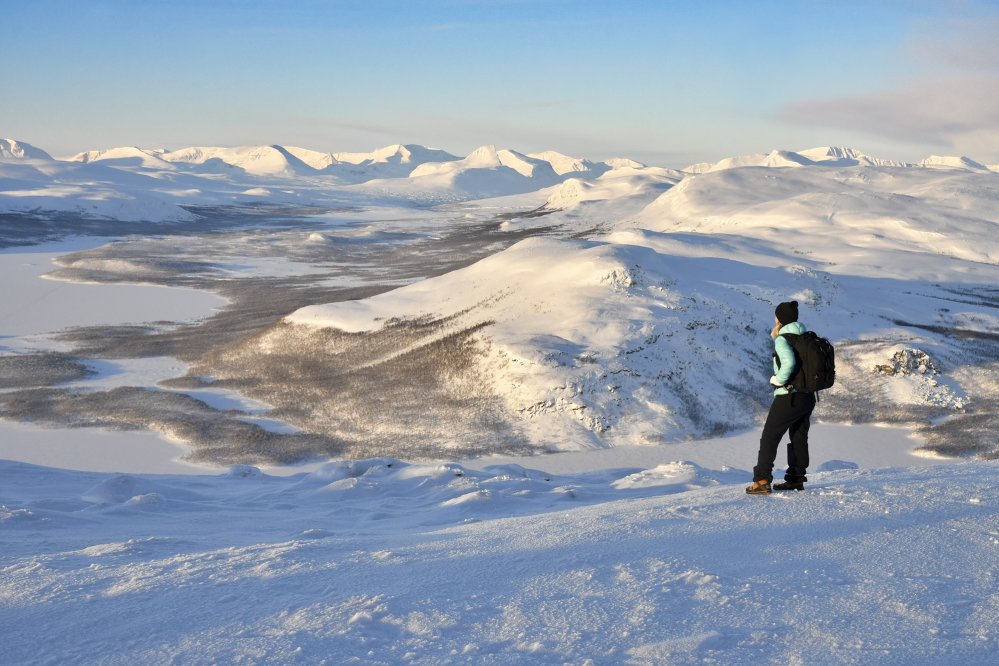
The views are breathtaking immediately above the tree line. Ranges of fells stretch endlessly into the distance, and on a clear day you can see for tens of kilometers in every direction.
At the top of the stairs, I stopped for my first proper breather and to capture the familiar view toward Malla Strict Nature Reserve and the Norwegian fells rising beyond it. The sun was climbing higher all the time, and soon it would reach the trail as well.
Because of the intense cold, I chose Sorel winter boots for this hike, with both a merino wool sock and a thick wool sock fitting comfortably inside. The Glacy Explorer model is noticeably lighter than the more familiar Caribou, making it a pleasant choice for longer winter walks.
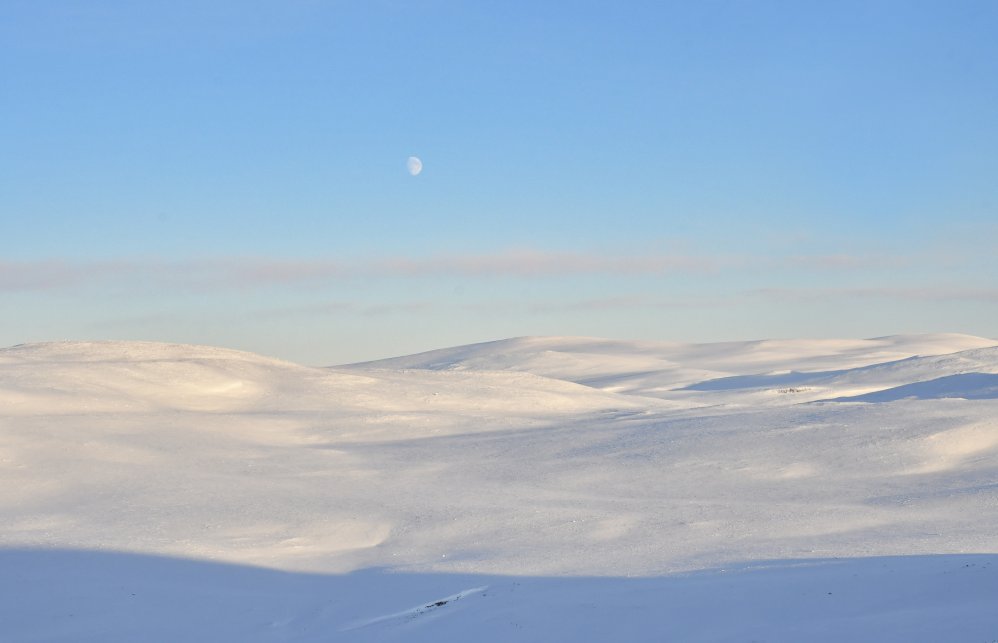
The sunlit area slowly began to expand, while the half-moon rose at the same time. Beyond the fells in the photo lies the Norwegian border.
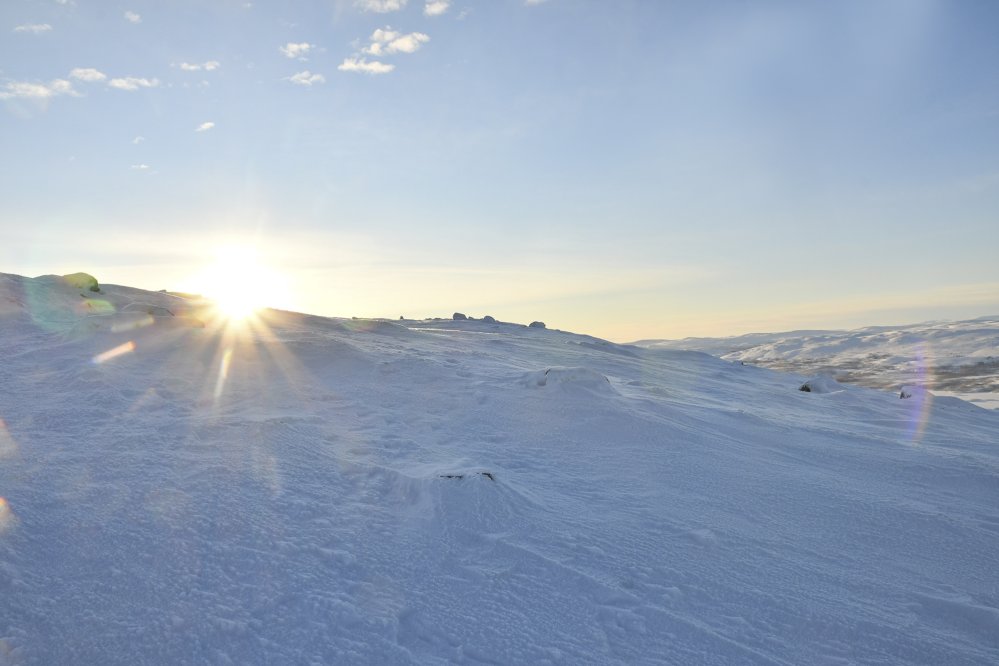
At last, the sun rose high enough to clear the slope of Saana. Its warmth touched my cheek immediately, and with the steepest section now behind me, the journey suddenly became much easier from this point on.
The snow on the slope of the fell had been packed so hard by the wind that I could easily walk even outside the marked trail without snowshoes. I did not see a single person behind me during the ascent, and I suspected that the bitter cold had persuaded most day hikers to wait for milder weather.
So when is it not a good idea to head for Saana? If the summit is hidden in cloud, much of the effort of the climb is, in a way, lost, as the views remain concealed. In conditions of very strong wind, rain, dense fog, heavy snowfall, or a snowstorm, ascending to the top is simply not safe.
There are also days when Saana’s summit appears cloud-covered when viewed from the village, yet the top itself is perfectly clear, allowing you to look down on a sea of clouds. This phenomenon is common in late autumn and can occur in winter as well.
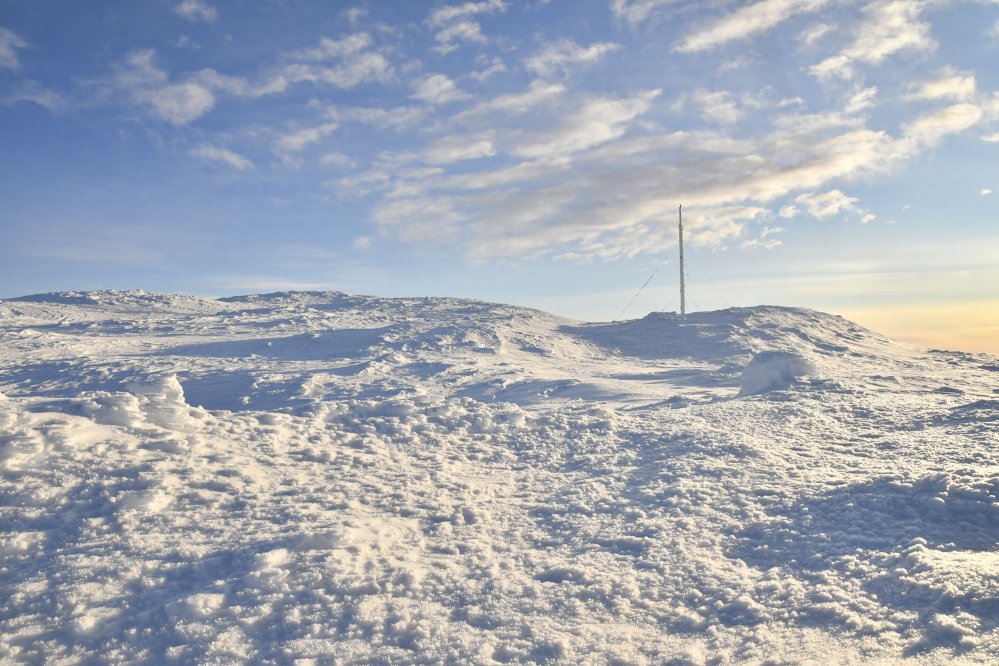
As Saana’s mast comes into view, you know that the highest point of the fell is already close. At the top, the terrain opens into a gently rolling fell plateau, and the steep climbs are now behind you.
From the top of the stairs, the steeper ascent continued for just under another kilometer. The moment I caught my first glimpse of Saana’s mast, the climb became mentally easier — the summit was no longer far away. I savored the perfectly calm air and the silence; that morning, I was the only person on top of Saana.
In Kilpisjärvi, one often finds oneself wondering whether these landscapes can truly be in Finland. Standing on Saana, the thought went even further — could these views really belong to Earth at all? The white, rippled snow cover, the blue-and-golden sky, and the horizon stretching endlessly in every direction felt almost otherworldly. Every trail marker, stone, and sign rising from the ground was entirely coated in wind-shaped snow and ice, transformed into pale, sculptural forms.
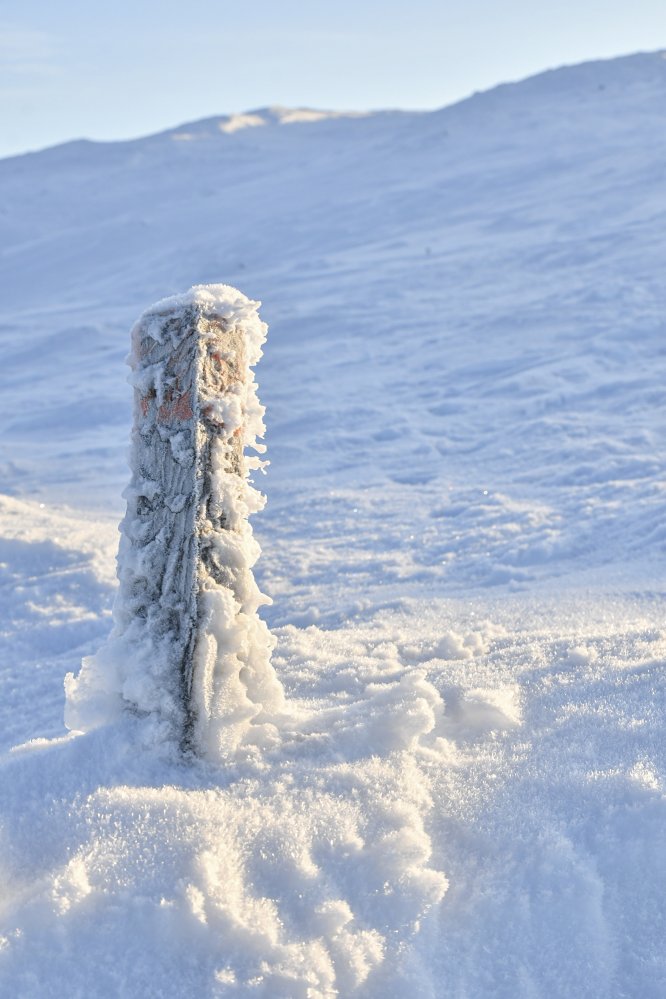
The wooden trail markers with their orange tops were visible along almost the entire route. However, some had been buried beneath the snow, while others were so completely coated in white ice that you would not have noticed them unless you already knew to look for them.
At last, I reached Saana’s mast and the wooden sign standing nearby — now the summit was only a stone’s throw away. My legs felt light again, and the entire climb was instantly forgotten. The view from Saana down toward the village of Kilpisjärvi truly opens up only at the very top, and I could hardly wait to cover those final few meters.
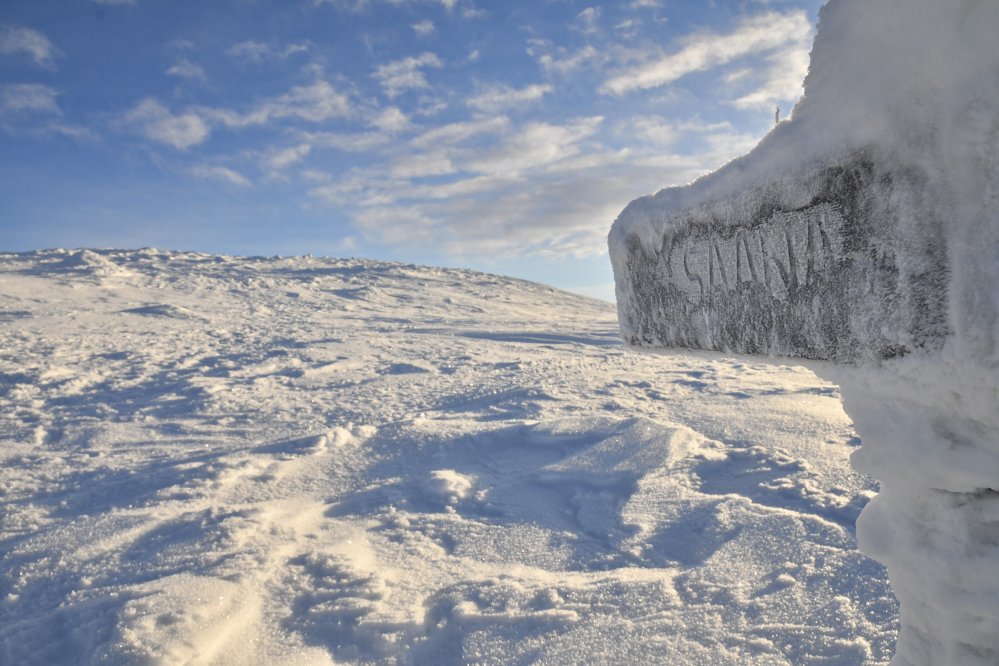
Almost there! A wooden sign points the way toward the highest point of the fell.
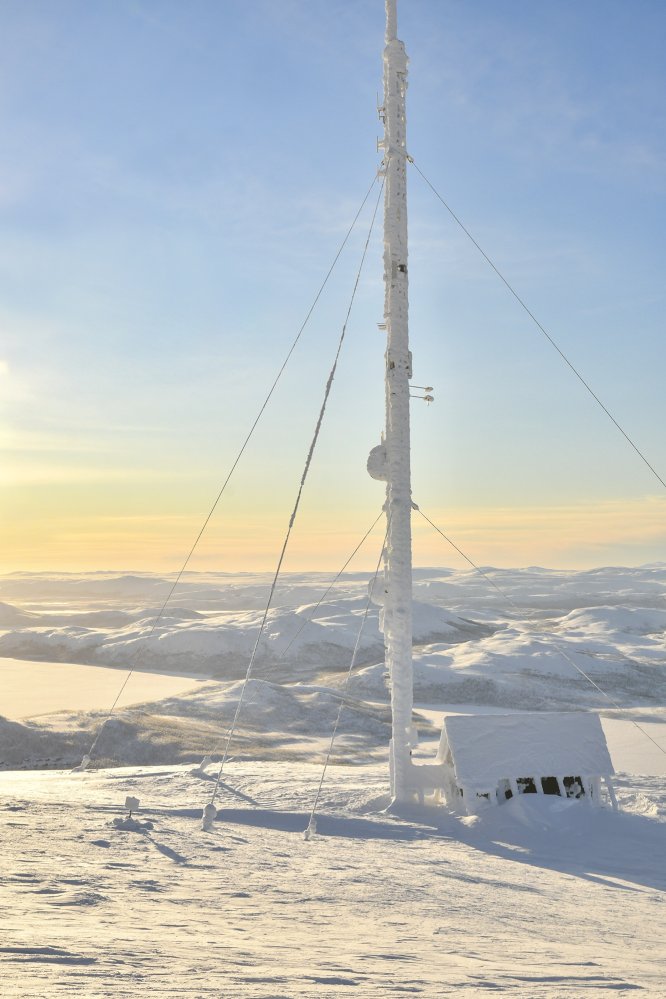
Saana’s mast is located closet to the highest point of the fell.
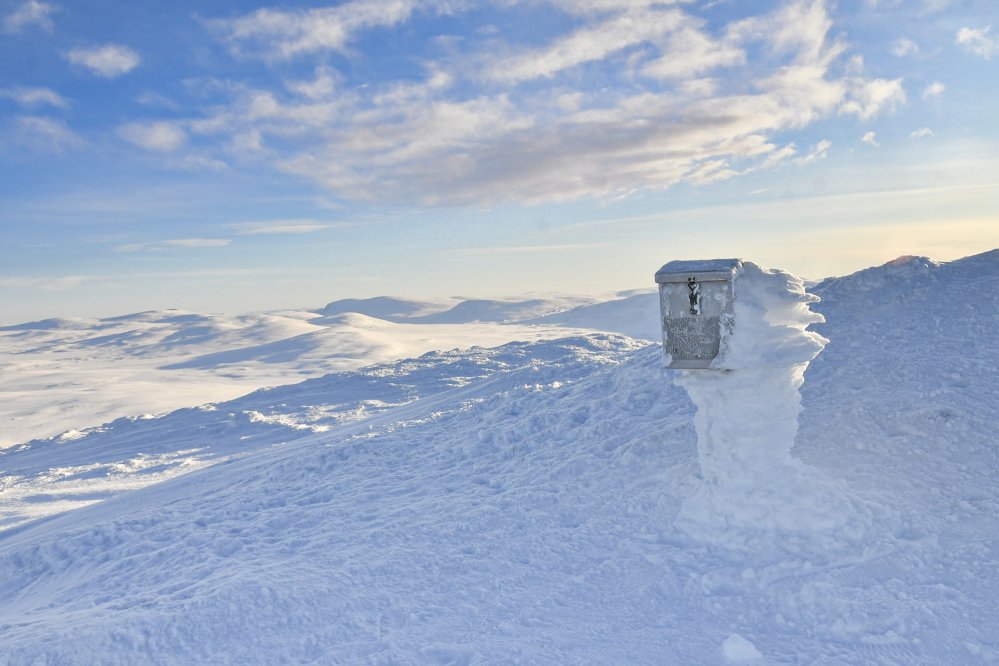
Finally at the summit! At this point I felt absolutely incredible, even though my legs were starting to feel the effort. Saana’s summit guestbook is kept in a metal box, and everyone who reaches the top is welcome to write their name in it. An estimated 30,000 people visit the summit each year, with most of them arriving between June and September.
At last, Saana’s metal summit box came into view, frozen solid by the winds of the Arctic Ocean. The top at last! The feeling was absolutely incredible – setting out despite the cold had truly been worth it. Even on the summit, the weather was perfectly calm, with only the distant sound of a snowmobile drifting up from far below.
I have to admit that as I wandered around taking photographs, I completely forgot to write my name in Saana’s guestbook. Perhaps I’ll have to climb up again soon to correct that mistake.
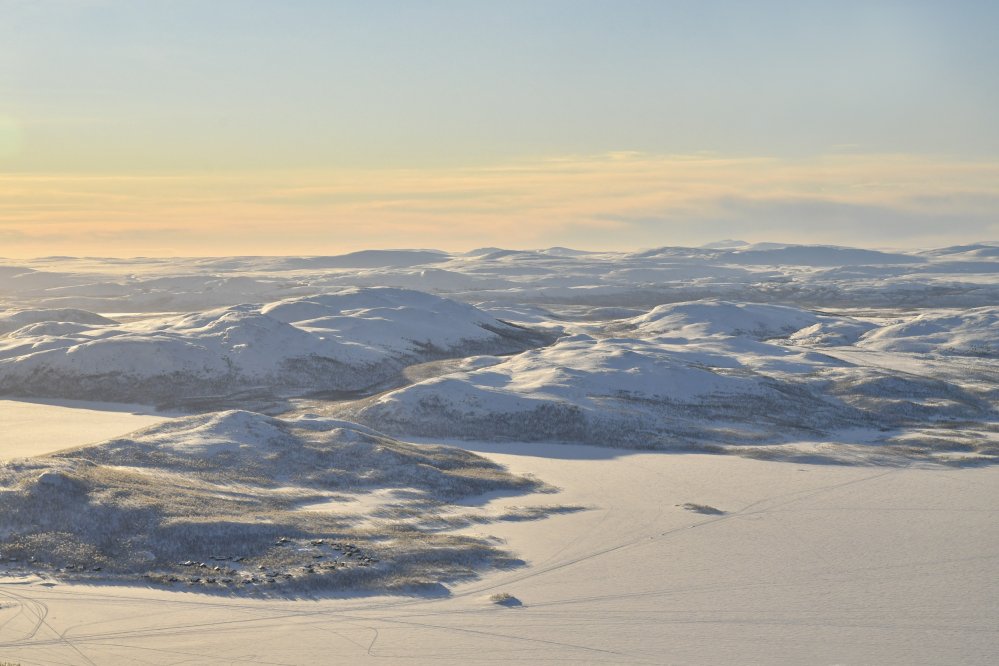
A view from the summit of Saana down toward Kilpisjärvi. The chains of fells continue far into Sweden, stretching beyond the reach of the eye.
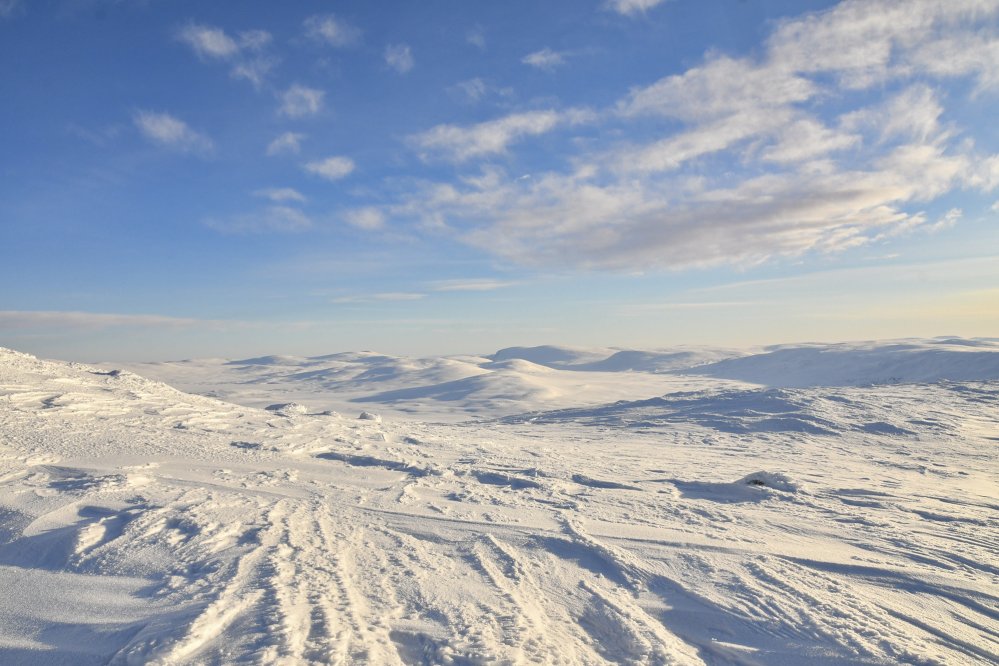
A view toward the Käsivarsi Wilderness Area.
After spending a while taking in the summit, the cold slowly began to creep in. I pulled a thicker down jacket from my backpack and changed into a dry beanie and buff. For a snack break, I chose a large rock slightly below the summit, on the side facing the village of Kilpisjärvi.
It is best not to venture too close to the edge of Saana, as the slopes are very steep. In addition, snow cornices that form along the rim of the fell collapse several times over the course of the winter. That said, those with a fear of heights need not worry on Saana – both the summit area and the entire trail remain well away from the sheer drops.
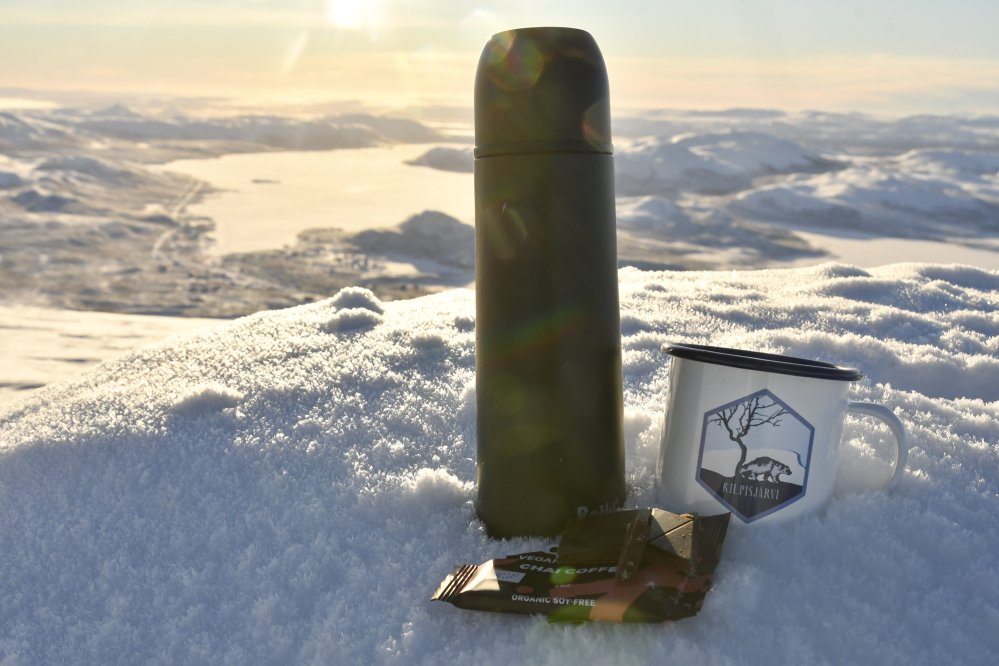
Tea had never tasted better!
The tea warmed me wonderfully, and before I even realized it, the entire small thermos was empty. After my snack, I decided to head back toward Kilpisjärven Retkeilykeskus, estimating that the descent would take a little over an hour.
On the way down, the views from Saana were even more spectacular, and stopping to take photos took
(perhaps unsurprisingly!) far longer than I had planned.
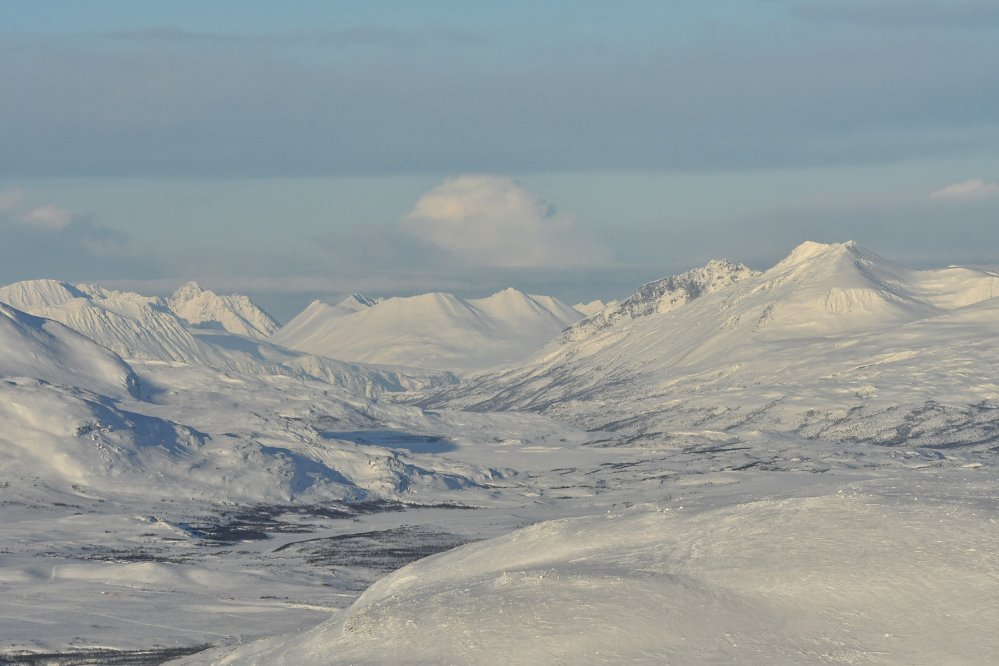
The Norwegian mountains are even more dramatic, and on the way back the view opens increasingly toward Norway.
After descending from the summit for about a kilometer, I finally encountered the first people coming up. By then, it was around one in the afternoon. A group of four young hikers were heading for the top, equipped with snowshoes and trekking poles.
Of course, this is entirely a matter of personal preference, but for some, especially poles can be very helpful on the ascent. On the other hand, if you take a lot of photos with your phone or camera, poles can sometimes feel more like an obstacle than an aid.
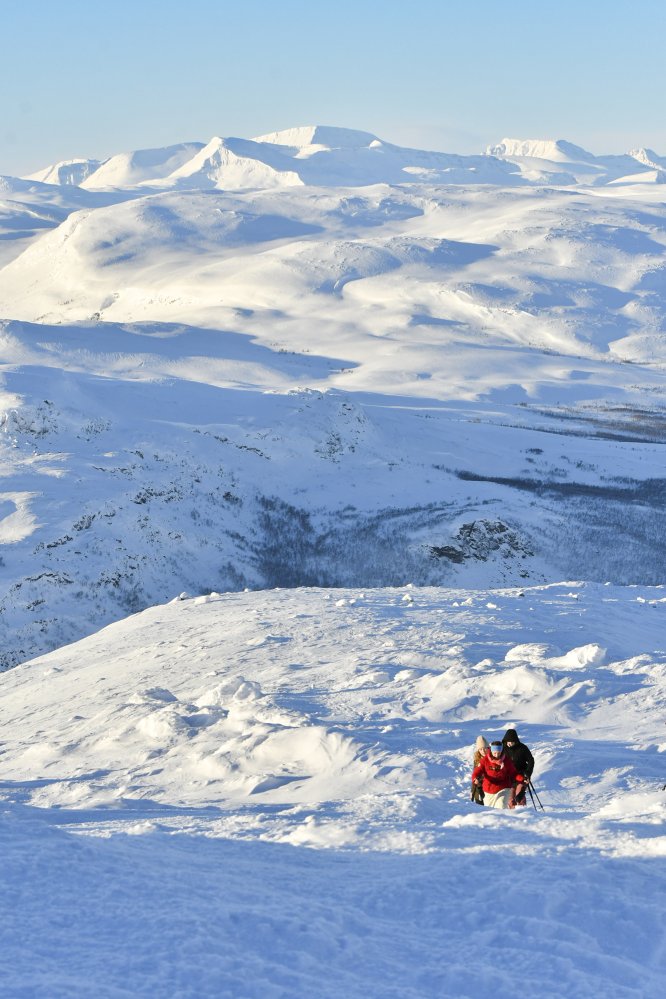
The first hikers I met on the way back down.
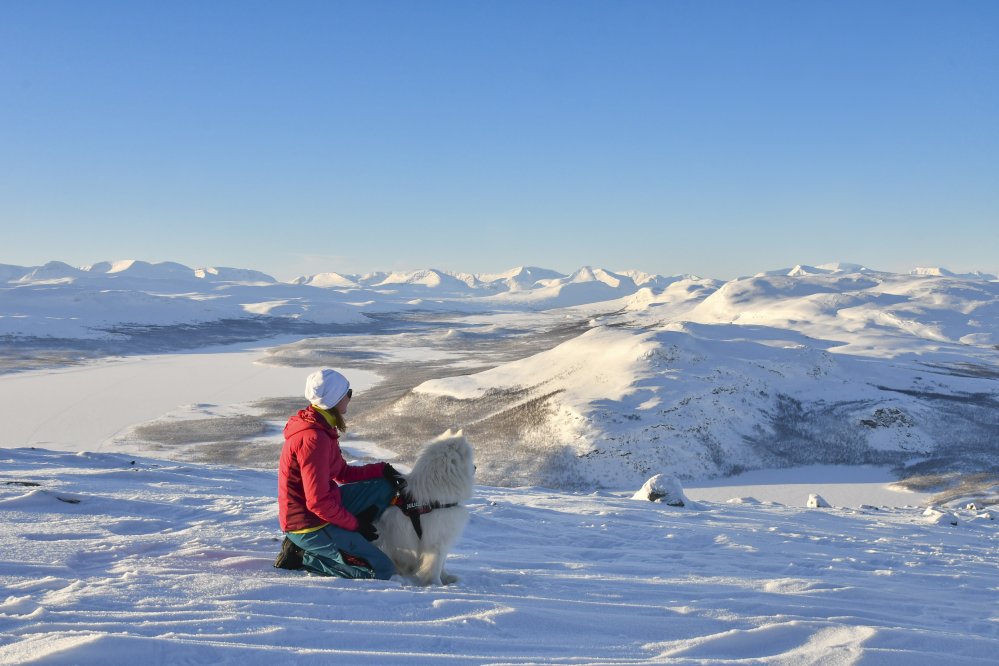
And just a kilometer later, the next ones appear! Around this point, near the top of Saana’s stairs, it’s a perfect place to stop for a breather.
Saana is also visited by many dogs throughout the year. When bringing a dog along in winter, it’s worth considering whether your dog might need protective clothing or booties – the Samo dog in the photo uses neither. You may also want to carry drinking water and some snacks for your dog.
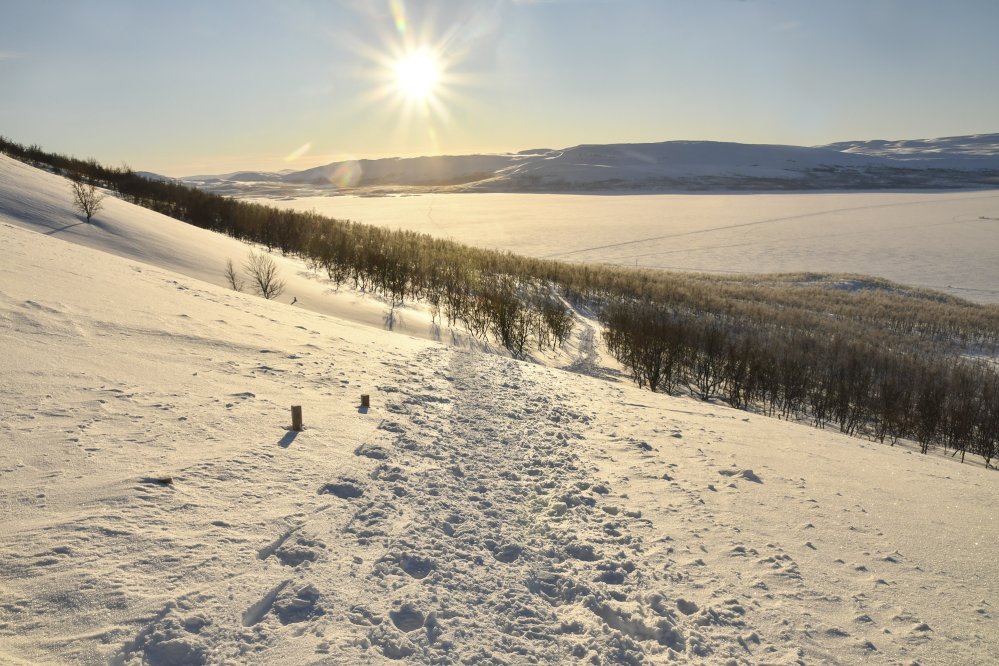
The descent is much quicker than the climb, though it is certainly felt in the thighs. In total, including breaks and taking around 200 photos, the entire trip took me 4 hours and 15 minutes.
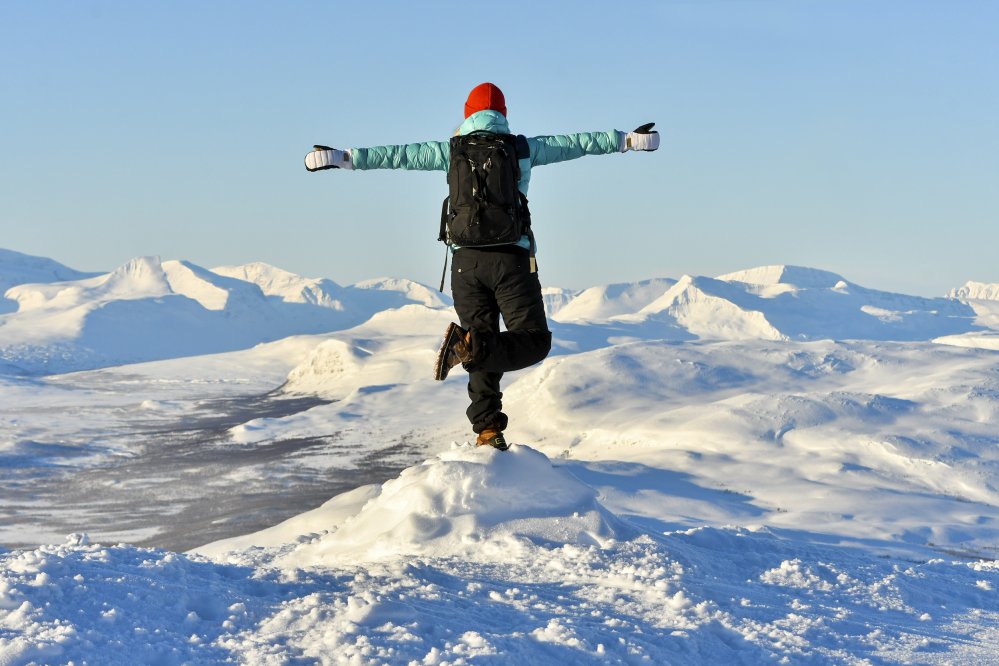
An absolutely unforgettable hike! Saana is a true must-see for every visitor to Kilpisjärvi. I hope you, too, will have the chance to reach the summit of Saana Fell one day.
Comments
no-comments