Saana Hiking Guide: Route, Equipment & Tips

What to wear, what to pack, and when and where to start – read our tips for conquering Saana in summer. Saana Fell is one of Finland’s most iconic hiking destinations, and for good reason. The dramatic fell landscape, the crystal-clear waters of Lake Kilpisjärvi, and the sweeping views all the way to Norway and Sweden make this hike an unforgettable experience.
1. Where does the hike to Saana begin?
There are two different starting points for the routes leading to the summit of Saana Fell. One begins at Kilpisjärven Retkeilykeskus, and the other at the parking area of Malla Strict Nature Reserve, located about 1.8 kilometres north of Kilpisjärven Retkeilykeskus. The two routes merge after just over one kilometre, after which everyone follows the same path to the summit.
The junction is located just above the tree line, which means that Saana’s famous stone stairs await hikers regardless of which starting point they choose. The staircase consists of just over 200 steps – depending on the counter, either 214 or 215 in total.
The so-called “old route” starting from Kilpisjärven Retkeilykeskus is the most convenient option for guests staying at the lodge and for hikers who do not need to park a car during the ascent. The newer, gravelled route from the Malla parking area is slightly longer but easier to walk. It is especially well suited for families with children and for those hiking with dogs.
Saana’s wilderness hut and dry toilet are located along the new route, though they are also only a short detour – a couple of hundred metres – from the old one. The parking area at Malla Strict Nature Reserve is free of charge and has no time limits; overnight parking, however, is not permitted.
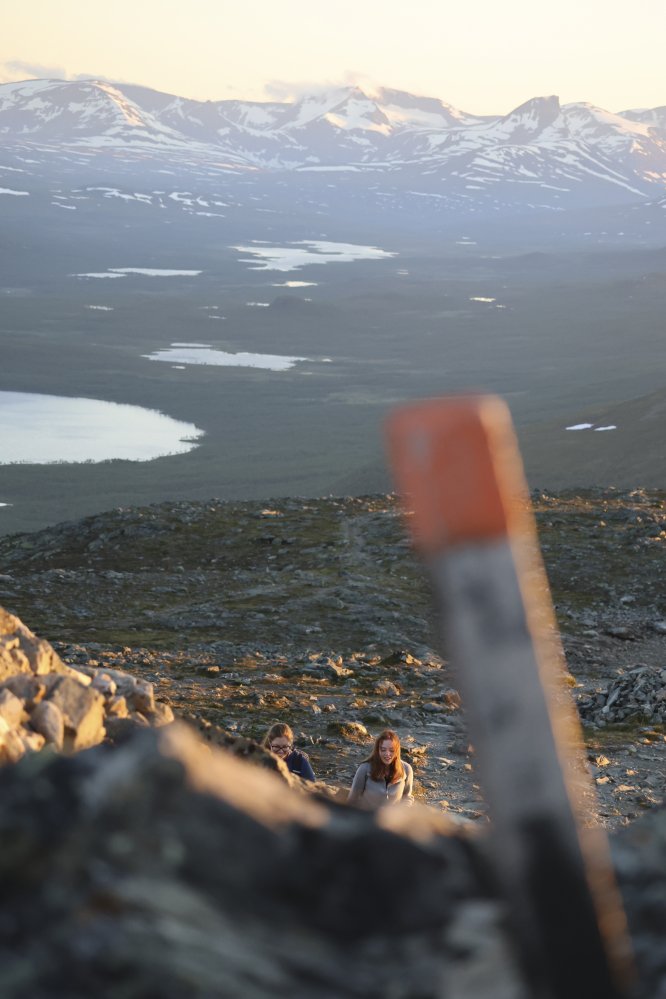
The Saana trail is clearly marked throughout with wooden posts topped with orange caps.
2. What is the trail like, and how long does a visit to the summit of Saana take?
The route to the summit is approximately 4 kilometres one way, making a total of about 8 kilometres round trip. The newer route is around 200 metres longer than the old one.
The trail to the top of Saana is marked throughout with wooden posts topped with orange caps. With the exception of the gravelled beginning of the new route, the path is mostly sandy and rocky, with several smooth bedrock sections along the way. In rainy conditions, the stones can be slippery, so it is important to choose footwear with good grip – sturdy trainers or hiking boots are recommended.
Both routes begin by winding through a fell birch forest, until after about one kilometre the trees fall away and the open fell landscape begins. Saana rises to 1,029 metres above sea level, while the village of Kilpisjärvi and the trailheads are already located at around 500 metres. This means the total ascent is just over 500 vertical metres.
The Saana trail is suitable for hikers of almost all ages and fitness levels, as long as you allow enough time, bring sufficient food and clothing, and set out in good weather.
Most visitors reach the summit and return within 3 to 5 hours, but there is plenty to marvel at on Saana’s slopes for much longer. If possible, leave your watch behind in the car park and enjoy the beauty of Saana all the way into the bright summer night.
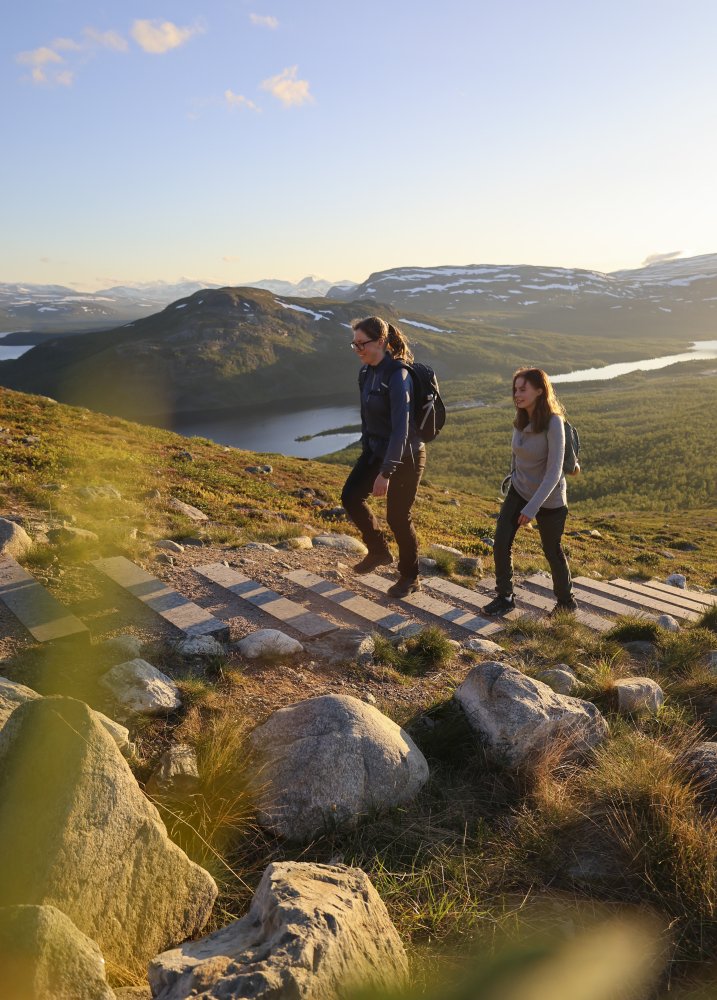
The stone steps on Saana were completed in 2019. Before that, the route featured longer wooden stairways.
3. When is the best time to set off?
During the season of the midnight sun, you can hike Saana at any time of day or night. In Kilpisjärvi, the midnight sun ends on July 25, but bright summer nights continue well into August.
The most popular time to visit Saana is during the day, when the trail is at its busiest. If you are looking for peace and solitude, it is worth heading up early in the morning or later in the evening. The soft light of Lapland’s summer nights makes an already stunning experience truly unforgettable.
Be sure to check the weather forecast carefully before setting out. If thunderstorms are predicted, it is best to skip the ascent altogether. Likewise, on overcast days when the summit is not visible from the village, it may be wise to postpone your hike until clearer conditions. An exception to this rule are the misty mornings of late summer, when the summit can be completely clear and rising “above the clouds” becomes a truly impressive experience.
It is also possible to hike Saana on a rainy day, but if the clouds hang low and there is no sign of clearing, you may find that there is nothing to see from the top at all.
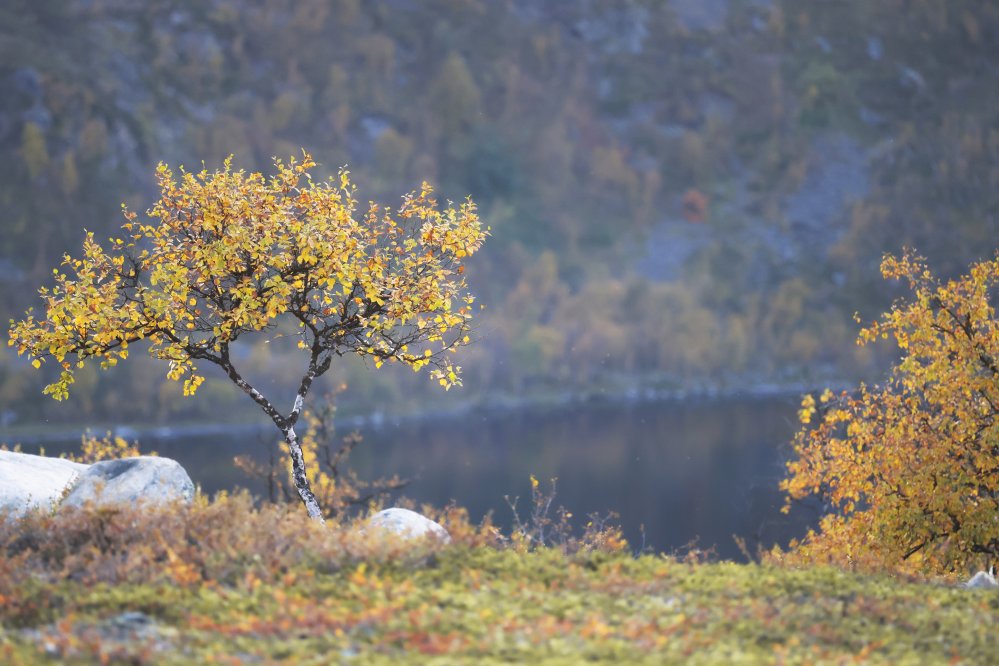
The autumn colours are at their most vibrant on the slopes of Saana roughly between September 5 and September 20.
4. What should you pack in your backpack?
Bring plenty of drinking water, especially in warm weather, as it is easy to become dehydrated. It is often chilly at the summit, and depending on the conditions, it is wise to pack a windproof jacket and possibly also a woollen sweater, gloves – and even in summer, often a beanie. Remember to bring good snacks and take breaks whenever needed.
Hiking poles are a welcome aid for many on the ascent of Saana. At Kilpisjärven Retkeilykeskus, you can both purchase your own poles or rent a pair for the day. However, if you plan to take a lot of photos along the way, poles may prove more of a hindrance than a help.
Be sure to carry a headlamp if there is even a small chance that your hike may extend into dusk or darkness. In Kilpisjärvi, nights begin to grow dark after mid-August, and in the fells twilight often arrives faster than you might expect.
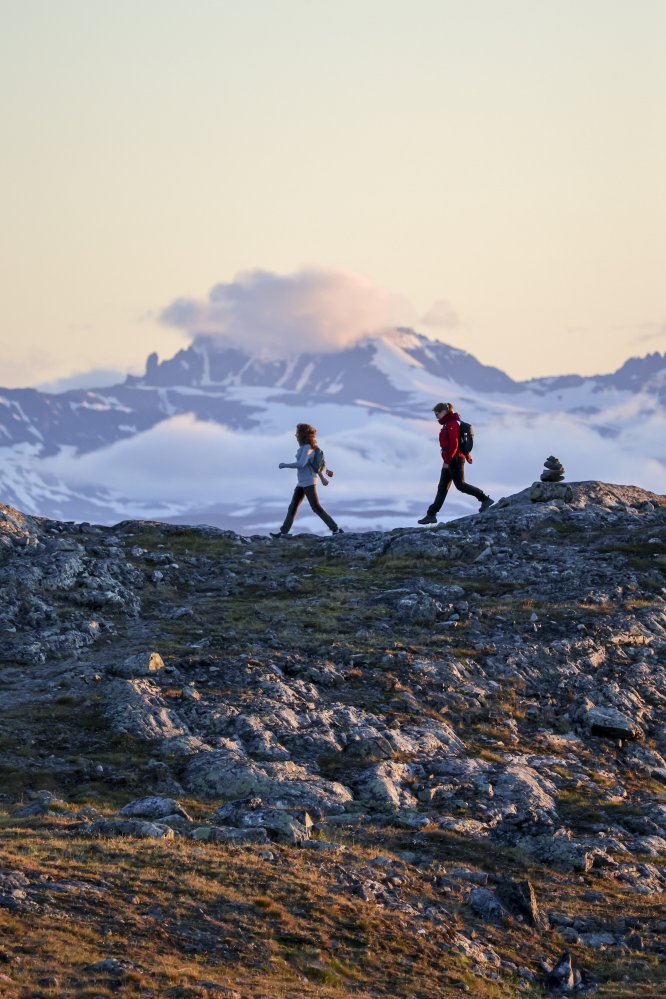
5. How should you dress for a hike to Saana?
The weather on the fell is often not dramatically different from that at the trailhead below. On the Finnish Meteorological Institute’s website, you can check the current temperature and wind conditions specifically at Saana’s observation point. As the old saying goes, it is always windy at the summit. In summer, the temperature at the top is usually a few degrees cooler than below; in winter, it can be the opposite.
On sunny and warm days, it is important to wear some kind of head covering and, of course, remember sunscreen – there is no natural shade on the fell.
Regardless of the weather, the ascent is a sweaty experience, and it is wise to have an extra layer to put on at the summit, or even a completely dry top, such as a base layer shirt. Even in summer, you may need gloves and a beanie or headband on Saana, and sometimes even a lightweight down jacket – especially if you plan to linger at the top. A windproof outer layer is almost always essential in Saana’s conditions.
For footwear, trail running shoes or hiking boots are suitable for a summer ascent. Many people reach the summit in ordinary running shoes, but it is safer to choose footwear with better grip. Good socks – for example, merino wool – improve comfort and help prevent chafing, as long as they do not slip or bunch up inside your shoes.
The closer autumn approaches, the cooler the weather becomes, especially in the evenings. Never underestimate the rapid weather changes in the fells – it is always better to carry too many layers than too few.
6. At the summit – what to expect?
From the top of Saana, breathtaking views open out over the Käsivarsi wilderness area: south toward the village and Lower Kilpisjärvi, west toward Sweden’s Pältsa, and north toward Norway’s dramatic mountain ranges. In these landscapes, many find themselves humming Haltin häät in their minds – the surrounding peaks are that impressive.
At Saana’s highest point, you will find a small box containing a guestbook. Write your name and the date – congratulations, you have reached the summit. The atmosphere at the top can feel almost unreal, especially after having thought several times along the way that you were already nearly there. Enjoy your achievement and take a moment to look around.
Remember to add layers as soon as you reach the summit, as sweat evaporates quickly and the chill can surprise you in the wind.
From Saana, familiar fells such as Salmivaara appear like modest little hills – from up here, an entirely new perspective on all of Kilpisjärvi unfolds.
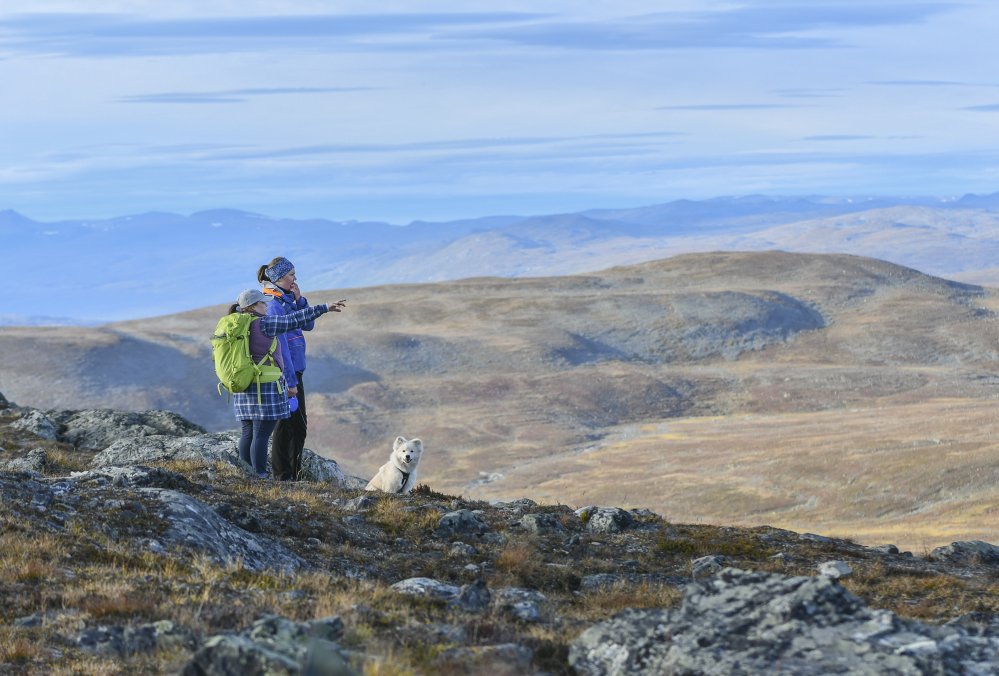
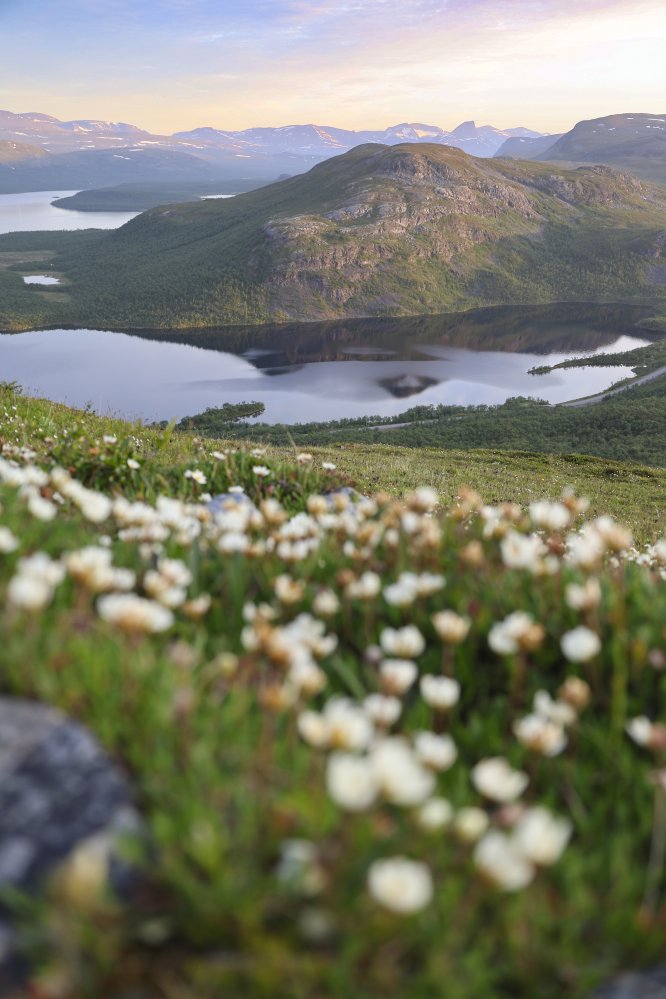
If you do not have the time or energy to continue all the way to the summit of Saana, this iconic and breathtaking view – familiar from so many photos – already opens up from the viewing platform at the top of Saana’s stairs. The distance there is about 1.5 kilometres from either starting point.
7. The return – getting back safely
On the way down, it is important to keep a calm pace and listen to your body. When you are tired, it is not wise to rush – that is exactly when the risk of stumbling or falling increases.
For many, the descent strains the legs just as much as the ascent, and hiking poles can be a great help in reducing the load on knees and ankles.
The stone steps on Saana, completed in 2019, can be slippery in rainy or damp conditions, especially on the granite sections. It is also wise to slow down on natural stone surfaces. Small, loose rocks may suddenly roll underfoot, so staying alert is essential throughout the entire descent.
If an accident occurs and you are unable to continue on your own, call the emergency number 112.
8. Frequently Asked Questions
“Can you hike Saana with children?”
Absolutely! For children, reaching the summit is often easier than for adults – and they are incredibly proud of their achievement. When hiking with children, it is especially important to pay attention to good snacks and sufficient hydration. Along the way, you can spot many plants and animals that are uncommon in southern Finland. Can you find the Lapland violet? What about the clubmoss? Who is that little bird wagging its tail and whistling sadly from a rock? Will you suddenly encounter a large reindeer herd escaping the heat? Saana is a grand adventure and a wonderful opportunity to learn about the unique nature of the Käsivarsi region and its high fells. Children around five to six years old are usually able to reach the summit on their own. At the reception of Kilpisjärven Retkeilykeskus, you can also rent child carrier backpacks for the youngest family members. The weight limits of the carriers are 18–22 kg.
“Can I bring my dog?”
Dogs visit Saana daily, and it is a pleasant walk for dogs in basic good condition. Be sure to bring drinking water for your pet, as there is very little water available along the trail. Dogs with sensitive paws may benefit from booties, if they are already used to wearing them.There is no sharp scree on Saana, but there is plenty of rock and bedrock. On rocky sections, pay attention if booties reduce your dog’s grip too much. On some warm evenings in July and August, blackflies can be intense in the fells, and a dog may quickly become uncomfortable.
“What about mosquitoes – do I need a head net?”
It varies. From around Midsummer until the end of August, mosquitoes, blackflies, and biting midges are part of the Kilpisjärvi summer. Fortunately, it is often windy on Saana, and the stronger the wind, the less trouble insects cause. In cool weather, they are rarely a problem at all. In general, Kilpisjärvi has fewer mosquitoes than many other parts of Lapland due to its open fell landscapes, high elevation, cooler climate, and fewer wetlands. If needed, repellents such as Off work very well. Kilpisjärven Retkeilykeskus sells several types of insect repellents, including options suitable for pets. We also stock mosquito head nets.
“Do I need a map?”
You do not need a map. The trail is mostly easy to follow and is well marked with black wooden posts topped with orange caps. Still, it is wise to keep paying attention to where the next marker is – there is so much beautiful scenery on Saana that it is easy to drift off the path in thought.
On the Luontoon.fi website, you can explore the Saana trail and other summer routes in the Kilpisjärvi area. Using your phone browser, you can check your location on retkikartta.fi, or alternatively with one of the many free or paid map applications available for download.
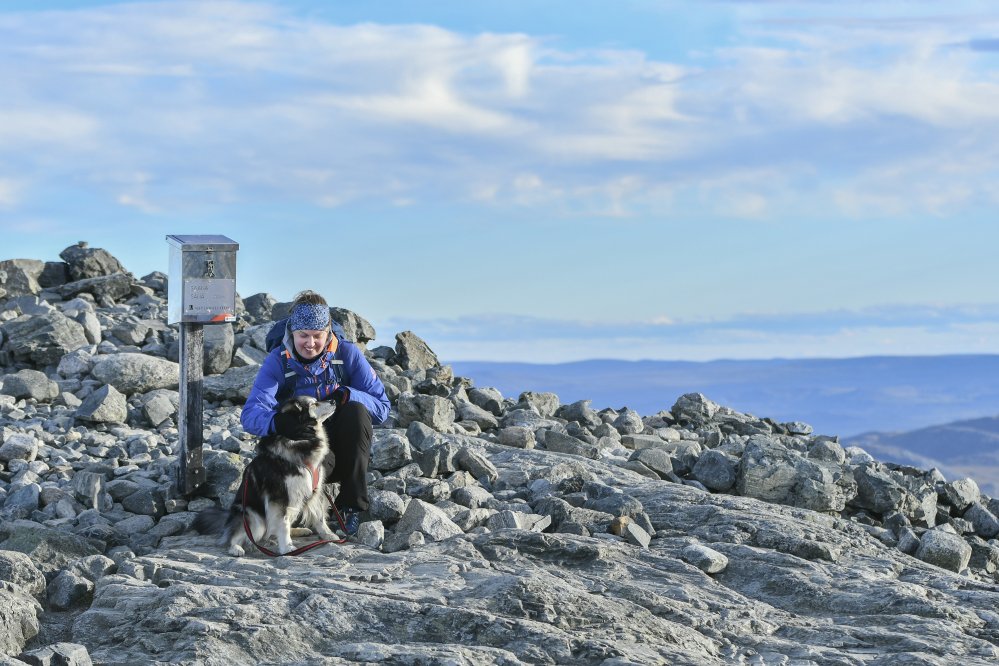
At the summit, you can write your name in Saana’s guestbook, found inside the small box at the top.
9. What can you see on Saana – and what should you look out for?
In early summer, almost as soon as the snow melts, life awakens on the fell. The first flowers to bloom are the bright pink alpine azalea (sielikkö), soon followed by Lapland rhododendron and the delicate Lapland pasqueflower.
Other beauties of the fell include clubmoss, alpine bearberry, mountain heather, the Lapland violet, and a rare treasure of barren rocky slopes: the Arctic buttercup. All of these plants of the Arctic region are small in size, yet all the more enchanting in their delicate beauty.
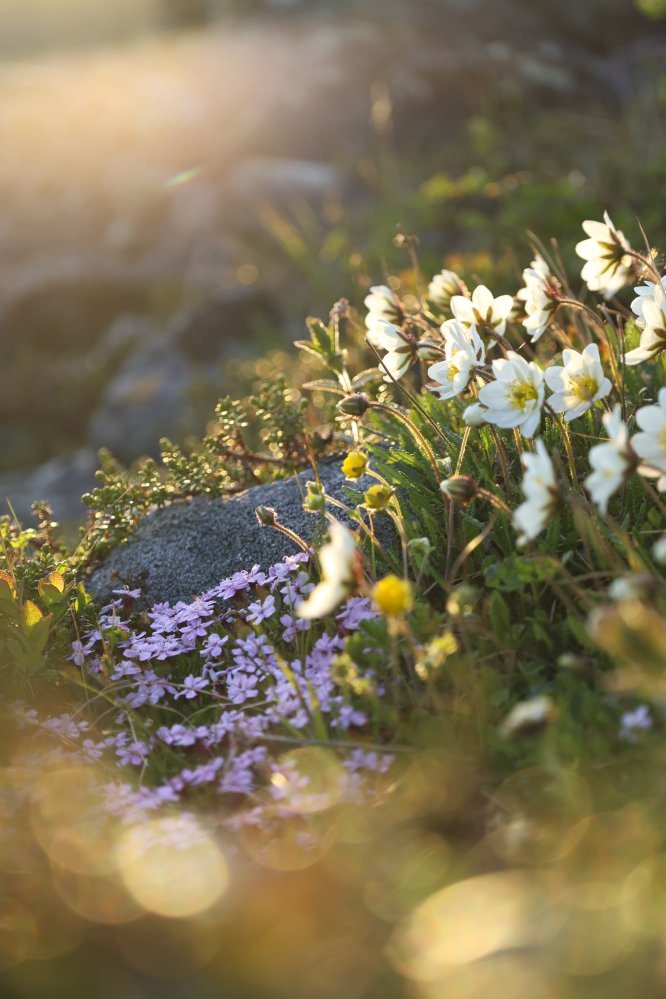
At first glance, the barren-looking fell slope provides an excellent habitat for plants that thrive in calcareous soil, such as the Lapland pasqueflower and alpine catchfly.
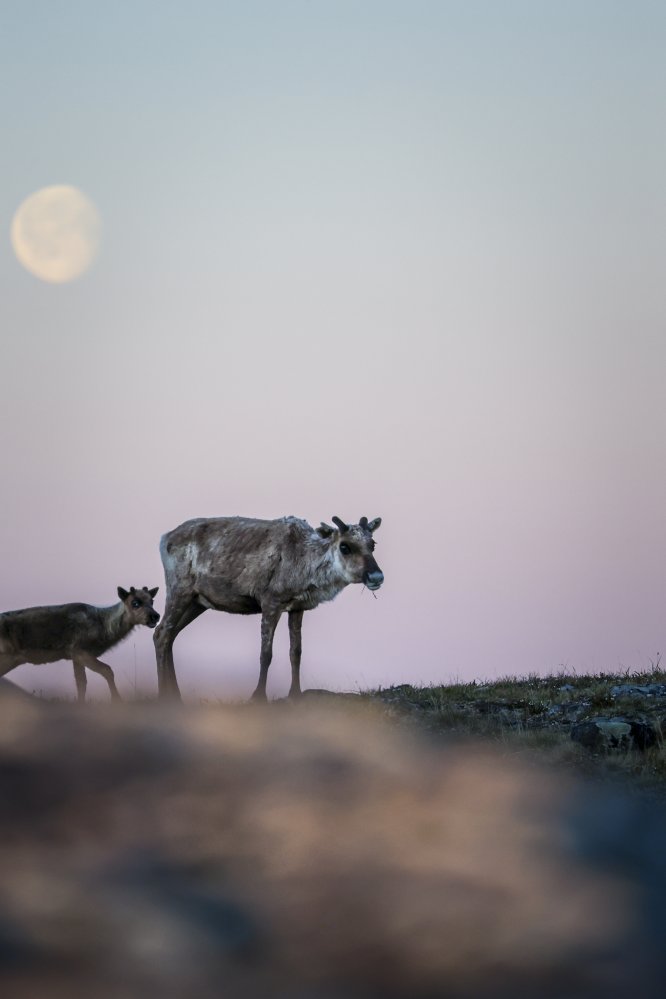
In summer, you may encounter a large herd of reindeer on the fell, seeking relief from insects and heat. Reindeer are almost tame, but you should still keep your distance. Disturbing a herd can cause the animals to scatter across the fell, and when that happens there is always a risk that a mother and her calf become separated. While on Saana, you will also most often see ptarmigan, close relatives of the willow grouse. Ptarmigan live above the tree line high on the fells, while willow grouse are found lower down in the fell birch forests.
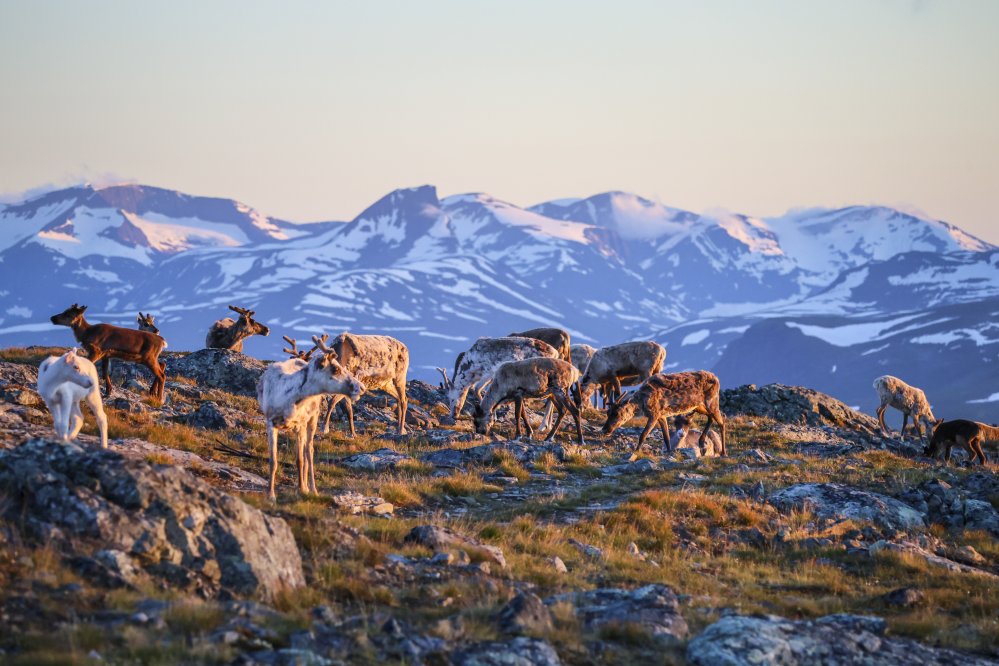
Reindeer gather on the slopes of the fell to escape the heat and swarming insects.
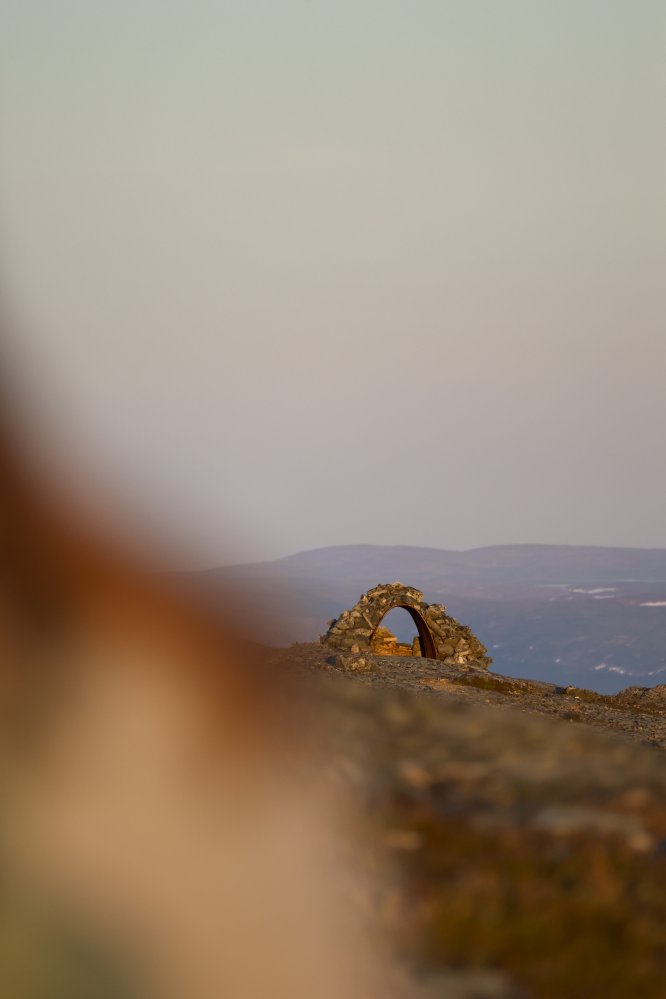
The traces of wartime history are also visible on the slopes of Kilpisjärvi. In the photo, you can see a former German observation post on the side of Saana Fell.
Saana’s history also includes a darker chapter. In the final stages of the Second World War, German forces began retreating north toward their defensive lines – the Sturmbock Line in Finland and the Lyngen Line in Norway. German positions were established in several locations around Kilpisjärvi, including Salmivaara, Malla Strict Nature Reserve, and the slopes of Saana.
Along Saana’s nature trail, you can learn more about the fate of prisoners of war and about a Junkers aircraft that crashed on Saana in 1942. Remains of the plane can still be seen in the terrain today.
10. What services are available along the trail?
Along the Saana trail, close to where the old and new routes meet near the tree line, there is a wilderness hut (kota) and a dry toilet. The hut is an open rest spot for all hikers, and firewood is provided. Overnight stays in the hut are not permitted, but camping is allowed in its vicinity in accordance with Everyman’s Rights. There are no waste bins along the trail – please do not leave anything on the fell, but carry out everything you bring with you. Remember that Saana is home to many Arctic animals and an important recreational area for the people of Kilpisjärvi and their pets. Several extremely rare flowers grow on Saana, and endangered butterfly species live here – many of them thrive only in this area and on a few other high fells in the Käsivarsi region. For this reason, it is especially important that we respect the fell’s fragile and precious nature: do not pick plants, trample vegetation, or leave litter behind – not even a tissue tucked between stones.
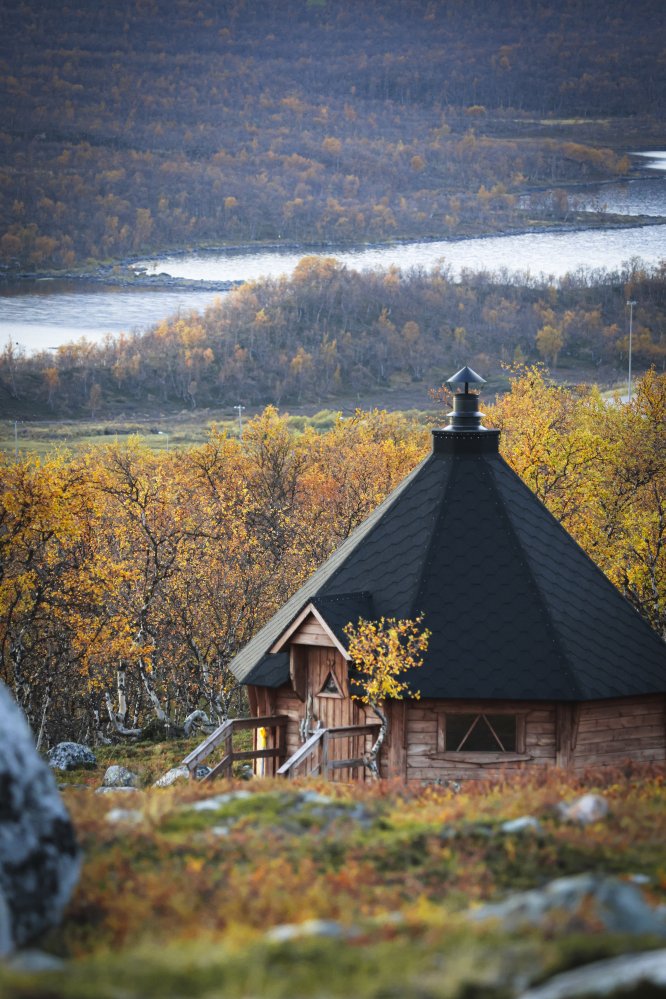
At Saana’s wilderness hut, you can enjoy a proper break and a snack. Overnight stays in the hut are not allowed, but camping is permitted in the surrounding area. A dry toilet is also available next to the hut.
Reward yourself after conquering Saana.
After your ascent of Saana, a delicious Saana pizza awaits you at Kilpisjärven Retkeilykeskus, along with a selection of unique souvenirs: T-shirts, tote bags, magnets, and other Saana-themed finds. Reaching the summit of Saana is one of Finland’s most unforgettable nature experiences. The fell changes with the seasons, the time of day, and the weather – no two hikes are ever the same.
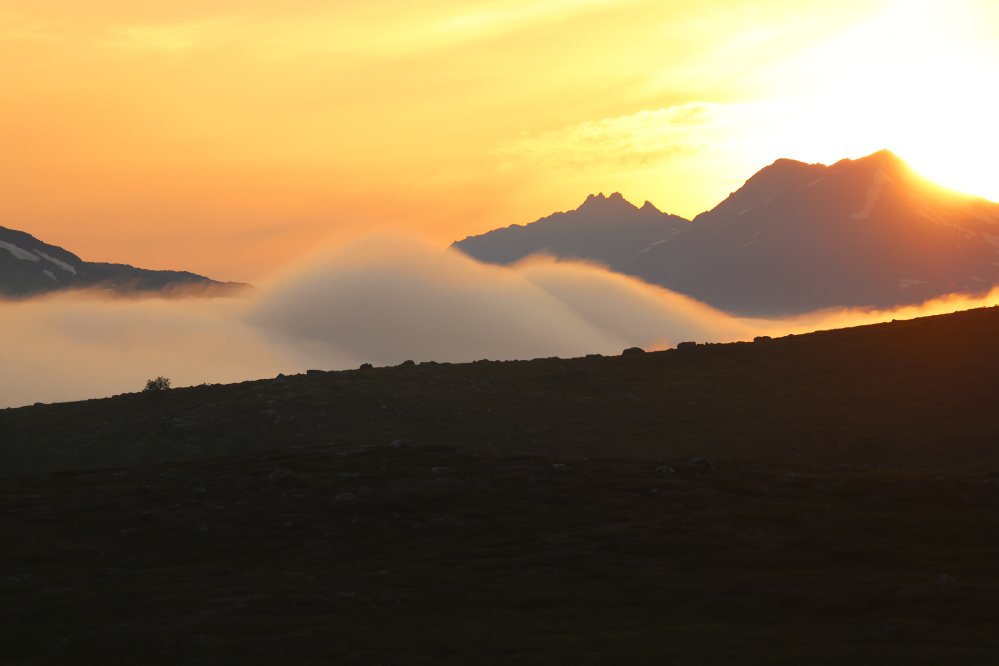
The sun rises after the midnight sun season from behind the fells of Norway.
Read also the winter version of the hike: Conquering Saana in Winter – Everything You Need to Know About Reaching the Summit in Snowy Conditions!
Comments
no-comments